
Biography
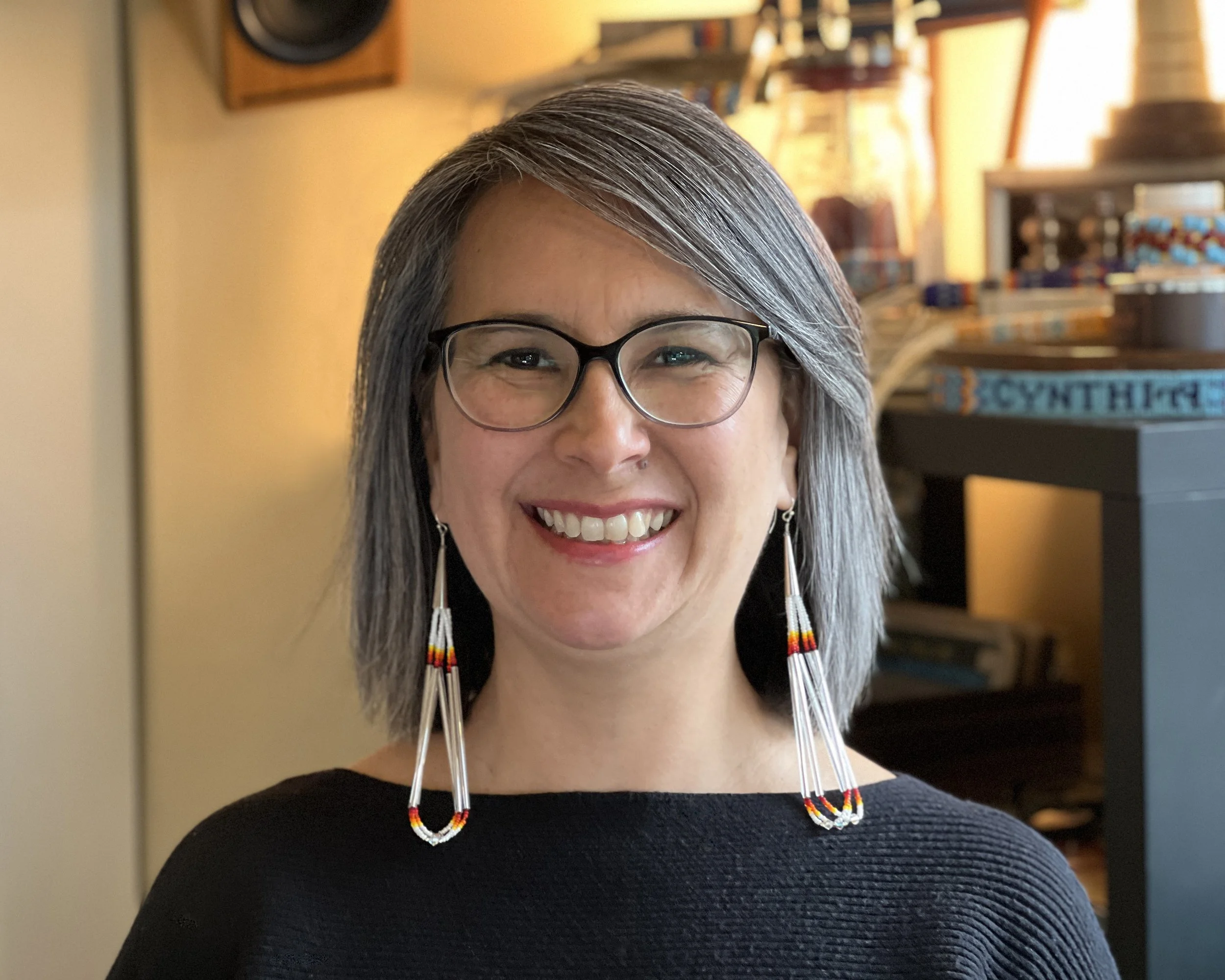
Oklahoma-born Seattle resident Cynthia Masterson (Comanche) beadweaves using deep knowledge of a misunderstood technique inconsistently called gourd or peyote. With grit and a VHS tape she taught herself to bead in 2003 and recently discovered eight ways to do the same stitch.
Her art combines writing, everyday objects and beadwork, creating assemblages with stories reacting to current events, loss of language, and time. Works have appeared at Red Earth Art Gallery, Washington State History Museum, Bellevue Art Museum, Columbia City Gallery and the yəhaw̓ exhibition at King Street Station.
Cynthia is a two-time First Peoples Fund Fellow, and received grants from Potlatch Fund, Puffin Foundation, The Evergreen State College Longhouse, 4 Culture, Artist Trust, Na’ah Illahee Fund and Seattle Foundation.
She founded Little Bead Library and Blue Dot Beadwork, where she encourages connection to culture through beads and specializes in showing pre-med students the relationship of beading to practicing medicine.
Technique
-
Three-drop gourd/peyote is a beadweaving technique done around cylindrical objects. The patterns are mathematically based and the designs are impossible without a lot of calculating, counting and re-counting before starting a project. This style is unique to Southern Plains tribes and is used on dance regalia, ceremonial items & everyday objects.
-
The word peyote refers to beadwork used in Native American Church (NAC) ceremonies where peyote is a sacrament. Outside the church beadwork was called gourd even if it was the same stitch. Many established beadworkers and elders follow this protocol. You won't find consistency on just which name to use since over time the term peyote was appropriated to describe many different beadwork styles
-
Beads are strung on, one at a time, creating a netting around the object. The beads stay on through proper thread tension, a good bead count and math.
-
Glass beads come from what is now Czechia. The region changed names through history - Bohemia to Czechoslovakia to Czech Republic to Czechia. The town of Jablonec nad Nisou north of Prague is the center of glass bead production. The abundance of sand, water, wood, and labor made this area ideal for glass making.
Glass beads are also produced other places like Japan, China, and India, but Czech beads are preferred by many Native artisans because of the history, quality, wide variety of colors, and faceted cuts make beadwork sparkle.
-
Seeds, bones, shells, and quills were early materials for adornment. When traders arrived with beads, Natives were captivated by colors they could hold in their hands. They used beads to cover clothing, ceremonial objects, footwear, and more. Today the love for beads endures.
Some beadweaving techniques are traced to Egyptian times. The 3-drop peyote/gourd technique of Southern Plains tribes is not seen anywhere else in the world and is thought to have originated in what is now Oklahoma.
Native Americans were introduced to glass beads as early as 1527 from explorers who brought beads for trade and gifts to what is now the United States. These beads were likely Italian or Bohemian.
-
A discerning eye can spot the difference between the 3-drop and 2-drop styles by looking at the starting row. There are two styles of 3-drop. The direction depends on whether you bead top to bottom and/or left to right. Other styles are also called 3-drop and 2-drop where beads are added 2, 3 or even up to 6 at a time. With the styles pictured below beads are added one at a time.

Resume
Cynthia Masterson, (b. 1970)
born Oklahoma City, Oklahoma
www.cynthiamasterson.com | cynthia@bluedotbeadwork.com | (206)718-7080
Exhibitions
2025 Evergreen Longhouse 30th Anniversary Exhibit The Evergreen State College Evergreen Gallery, Olympia, Washington
2025 Answer as Question, Response to Ai, Rebel: The Art & Activism of Ai Weiwei Columbia City Gallery, Seattle, Washington
2025 In Her Eyes, Red Earth Art Center, Oklahoma City Oklahoma
2025 In the Spirit, Washington State History Museum, Tacoma, Washington
2025 Itty Bitty, Base Camp Studios, Seattle, Washington
2025 Sleeping Beauty Community Day Guest Artist, Pacific Northwest Ballet, Seattle, Washington
2024 In the Spirit, Washington State History Museum, Tacoma, Washington
2022 In the Spirit, Washington State History Museum, Tacoma, Washington
2022 Sunset Hill Walking Art Fair, Seattle, Washington
2021 The Longhouse at 25 Across the Waters, The Evergreen State College House of Welcome, Olympia, Washington
2021 In the Spirit, Washington State History Museum, Tacoma, Washington
2021 Sunset Hill Walking Art Fair, Seattle, Washington
2020 Oklahoma Indian Festival Virtual Markets
2020 Sunset Hill Art Walk, Seattle, Washington
2020 In the Spirit, Washington State History Museum, Tacoma, Washington
2019 Bellevue Bellwether, Bellevue Art Museum, Bellevue, Washington
2019 In the Spirit, Washington State History Museum, Tacoma, Washington
2019 Yehaw, King Street Station, Seattle, Washington
2018 AWE – Artistic Women Endeavors, MADE Co-working, Seattle, Washington
Media
Denn, Rebekah. “Help Your Shelf.” Seattle Times January 5, 2025
https://www.bluedotbeadwork.com/s/SeattleTimesLibraryArticle.pdf
Lee, Judy. “Native American Heritage Month Spotlight: Bead Artist Cynthia Masterson”. Cultures Connecting October 30, 2024
https://www.culturesconnecting.com/post/native-american-heritage-month-spotlight-bead-artist-cynthia-masterson
Sawyer, Sarah. “Mastering & Teaching the 3-Drop Gourd Stitch with Blue Dots.” First Peoples Fund, First Peoples Fund, 27 July 2020,
www.firstpeoplesfund.org/news/2020/7/27/mastering-amp-teaching-the-3-drop-gourdstitch-with-blue-dots .
Two Feathers, Raven. yəhaw̓, June 2019, yehawshow.com, Cynthia featured at 1:42.
Burke Museum, Burke at Home, https://youtu.be/p-lPkBUpU88, June 22, 2020
Teaching
2026 Guest Artist, Museum of Flight, Closing Day The MiG-21 Project
2025 Guest Instructor, Oregon Health & Science University,
Post-bac Pre-med Wy-east Pathway
2025 Guest Artist, The MiG-21 Project Opening Day, Museum of Flight, Seattle, Washington
2025 Lunchtime Bead Lounge, Red Earth Arts Center, Oklahoma City, Oklahoma
2025 Presenter, Indigenous Peoples Day, Seattle Center, Seattle, Washington
2024 My Favorite Things, Joyce J. Scott Walk a Mile in My Dreams, Seattle Art Museum
2022 Guest Instructor, Oregon Health & Science University, Post-bac Wy-east Pathway
2022 University of Washington Native Scholars
2021 Pratt Fine Arts Amazon Expressions Adjunct Instructor
2021 Western Heights Indian Education Program - Oklahoma City Oklahoma
2020 Oklahoma Indian Festival Virtual Markets
2020 Walters Public School Indian Education - Walters, Oklahoma
2020 Guest Artist, Thomas K. McKeon Center for Creativity
2020 Presenter, Native Action Network, Native Women’s Leadership Forum
2020 Guest Instructor, Oregon Health & Science University, Post-bac Wy-east Pathway
2020 Instructor, University of Washington Center for American Indian and Indigenous Studies
2019 Presenter, Shoshone Numic Language Conference
2017 – to present, Self-produced video tutorials,www.youtube.com/c/BlueDotBeadwork
2014 First-time Teacher, Seattle Indigenous People’s Festival at Seattle Center
Grants
2024 Na’ah Illahee, Power of Ceremony Grant
2024 Potlatch Foundation, Community Relations & Innovations Grant
2023 Seattle Foundation Gather Grant
2022 Potlach Resiliency Grant
2022 4 Culture, Projects: Individuals program
2020 Evergreen State College Longhouse COVID-19 Video Grant
2020 Na’ah Illahee Fund Native Community Crisis Fund
2020 Potlach Foundation Critical Response Grant
2019 Potlach Fund Native Arts Grant
2015 Puffin Foundation
2014 The Evergreen State College Longhouse Native Creative Grant
Awards
2022 Artist Trust, Grants for Artists' Progress (GAP) Award
2022 Washington State History Museum, In The Spirit Purchase Prize
2019 First Peoples Fund Cultural Capital Fellowship
2015 First Peoples Fund Artist in Business Leadership Fellow
2014 Tulsa State Fair, Blue Ribbon, Beadwork Category
Juror
2025 Artist Trust SOLA (Support Old Lady Artists) & Twining Humber Award