
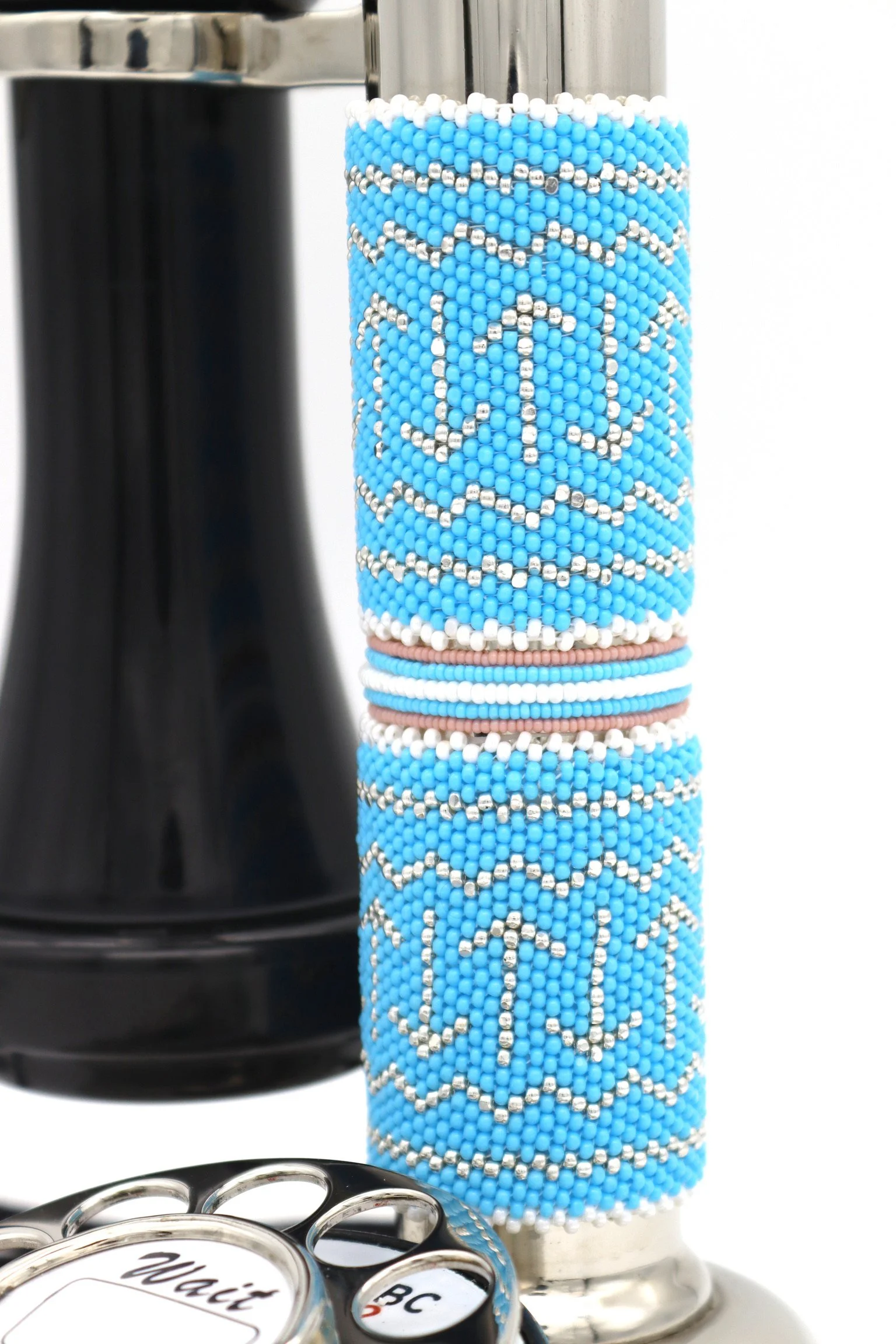
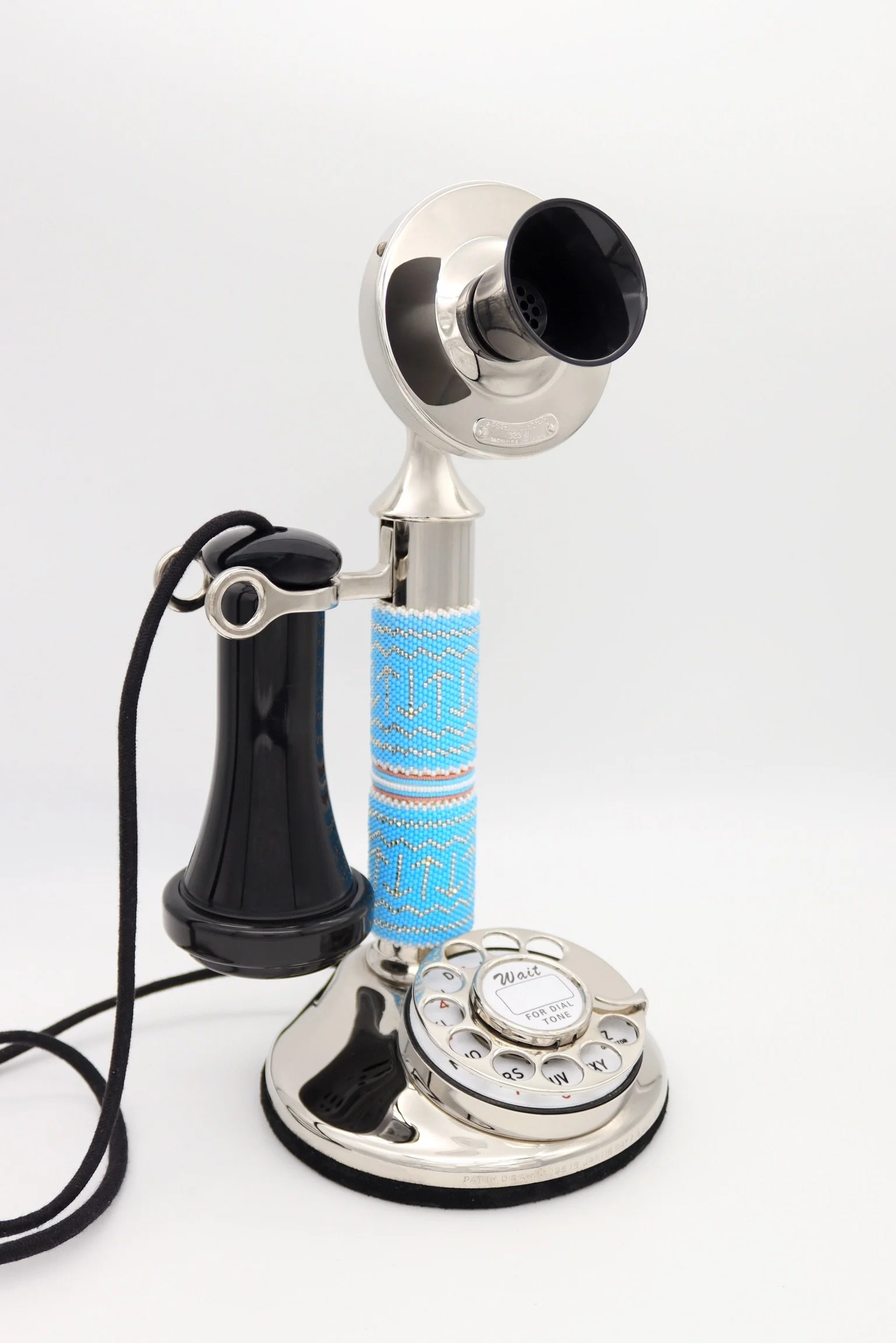

Originally named Silver and Sky then Ask-a-Beader and currently A Game of Telephone. This restored Western Electric candlestick telephone is an evolving piece intended to demonstrate two similar, but slightly different bead weaving styles and show three bead sizes. Peyote beadwork is widely misunderstood due to inconsistent naming protocols and difficulty distinguishing the multitude of styles.
A Game of Telephone
Here are two similar but slightly different bead weaving styles on a Western Electric candlestick telephone restored and nickel plated by Old Phone Works. Wrapped in the middle are three sizes of beads: 11/0, 13/0 & 15/0. The numbers refer to the number of beads per inch stacked top to bottom as you see in beadweaving, not as strung side by side on a thread. Above and below the wrapped beads are two techniques of beadweaving. The beads are cut-glass Czech beads woven with K.O. beading thread.
Czech refers to the country of Czechia, formerly known as the Czech Republic and Czechoslovakia. The town of Jablonec nad Nisou north of Prague has been a center of glass bead production since the 1500s.
The technique on top is thought to originate on the Southern Plains by Comanches or Kiowas. Research in Native American beadwork is lacking but Gerald R. Hubbell theorizes in his 1979 paper that this stitch emerged in the 1800s referring to the technique as peyote stitch proper. Peyote stitch proper was not seen outside of the North American Southern Plains Pre-European contact.
Peyote beadweaving is widely misunderstood due to inconsistent naming conventions and confusion with another similar stitch. The peyote descriptor has been used as a catch all for many styles including two-drop, three-drop, tubular, even count, odd count, flat, diagonal, circular and more. Peyote has become such a vague and inaccurate description it has lost it’s original meaning. How this happened is like a Game of Telephone, where a message is whispered down a line of people distorting each time the message is passed.
In Native American Church (NAC) ceremonies peyote is taken as a sacrament. This is where beadweaving starts to be called peyote. To further conflate the peyote descriptor, the terminology gourd and peyote were used interchangeably referring to the very same stitch. If it was on Native American Church items, it was called peyote. Outside the church called gourd.
The same stitch had different names according to how they were used. Early beadworkers did not speak English as a first language. Perhaps there are other names that are lost to history and The Game of Telephone.
The technique below is seen in Ancient Egyptian artifacts and has similar confusion as peyote stitch proper. What Egyptians called it is lost to time. While this style is seen throughout Europe on purses it is different than peyote stitch proper. Beading techniques Europeans adopted weren’t always given names as it became fashionable for ladies to bead in the Victorian era. You might see this style on handbags from that time, but it is not peyote stitch proper.